


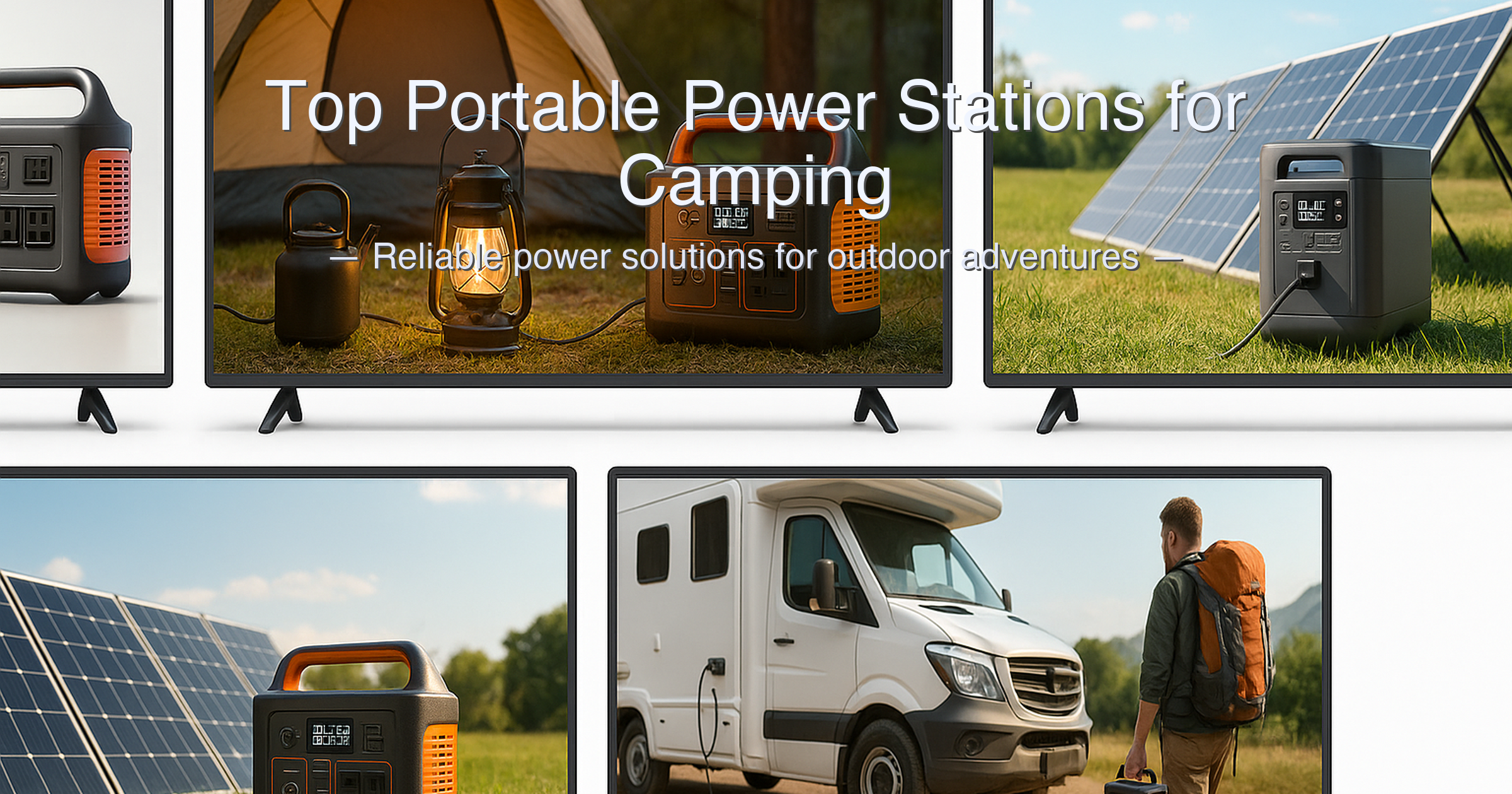
By Joe Botrous · 14 min read · First published April 2026. Updated regularly as new products launch and specs are verified.
FlexiViews is a participant in the Amazon Services LLC Associates Program. As an Amazon Associate, we may earn from qualifying purchases at no extra cost to you.
Here’s what most portable power station roundups get wrong: they treat a 7-pound camping battery and a 92-pound whole-home backup system as the same product category. They’re not. Picking the wrong tier doesn’t just waste money — it means either carrying a brick to a campsite or running out of power halfway through a blackout.
This guide covers five picks across four distinct use cases — compact camping, extended camping or van life, home backup, and expandable whole-home power — and is honest about which product belongs in which scenario. Every capacity figure, output rating, and charging time is verified against manufacturer specs. Where data was missing from listings, it’s been sourced from official product pages and noted.
What we evaluated:
- Capacity (Wh) and real-world output wattage
- AC charging time (wall outlet, fully verified)
- Solar input capacity for off-grid use
- Weight and portability for the intended use case
- Battery chemistry and cycle life
- Expandability and warranty terms by brand
Based on verified manufacturer specs, official product pages, and Amazon listing data. Charging times sourced directly from manufacturer documentation.
Table of Contents
- Quick Picks at a Glance
- Watch: Portable Power Stations Explained
- Specs at a Glance
- How We Chose These Power Stations
- 1. Jackery Explorer 300 — Best for Compact Camping
- 2. BLUETTI Elite 200 V2 — Best for High Capacity
- 3. Jackery HomePower 3000 — Best for Home Backup
- 4. Anker SOLIX F3800 — Best for Versatility
- 5. EF EcoFlow DELTA 3 Ultra Plus — Best for Expandability
- Side-by-Side Comparison
- Buying Guide
- Frequently Asked Questions
- Final Verdict
Quick Picks: Portable Power Stations at a Glance
| # | Product | Best For | Capacity | Output | Score | Price Tier |
|---|---|---|---|---|---|---|
| 1 | Jackery Explorer 300 | Compact Camping | 293Wh | 300W | 8.1 | Budget |
| 2 | BLUETTI Elite 200 V2 | High Capacity / Van Life | 2,073.6Wh | 2,600W | 9.5 | Premium |
| 3 | Jackery HomePower 3000 | Home Backup | 3,072Wh | 3,600W | 9.3 | Premium |
| 4 | Anker SOLIX F3800 | Versatility / RV | 3,840Wh | 6,000W | 9.4 | Ultra-Premium |
| 5 | EF EcoFlow DELTA 3 Ultra Plus | Expandability | 3,072Wh | 3,600W | 9.6 | Ultra-Premium |
Watch: Portable Power Stations Explained
Specs at a Glance
| Model | Capacity | AC Output | AC Charge Time | Solar Input | Battery Type | Weight | Price Tier |
|---|---|---|---|---|---|---|---|
| Jackery Explorer 300 | 293Wh | 300W | ~2 hrs to 80% ⚠️ | Up to 100W | Lithium-ion ⚠️ | 7.1 lbs (3.2 kg) | Budget |
| BLUETTI Elite 200 V2 | 2,073.6Wh | 2,600W | ~50 min to 80% (dual AC+DC) | 1,000W | LiFePO4 | 53.4 lbs (24.2 kg) | Premium |
| Jackery HomePower 3000 | 3,072Wh | 3,600W | 2.2 hrs | 2,400W | LFP | Check listing | Premium |
| Anker SOLIX F3800 | 3,840Wh | 6,000W | ~2.1 hrs | 2,400W | LiFePO4 | 92.6 lbs (42 kg) | Ultra-Premium |
| EF EcoFlow DELTA 3 Ultra Plus | 3,072Wh | 3,600W | 89 min to 80% via AC | 1,600W | LiFePO4 | 74.3 lbs (33.7 kg) | Ultra-Premium |
AC charging times sourced from manufacturer product pages and verified against independent reviews. Solar input is maximum supported wattage under ideal conditions. ⚠️ Jackery Explorer 300 (B082TMBYR6) uses standard lithium-ion chemistry (800 cycles), not LiFePO4 — that upgrade applies to the newer 300 Plus and 300 v2 models. BLUETTI 50 min figure requires simultaneous dual AC+DC input; AC-only Turbo mode is ~1 hr to 80%.
How We Chose the Best Portable Power Stations
- Capacity and output matched to use case: We deliberately selected across the full capacity spectrum — from the 293Wh Jackery Explorer 300 (genuinely portable at 7.1 lbs) to the 3,840Wh Anker SOLIX F3800 (home and RV-grade). Each product is evaluated against the use case it was designed for, not against a single yardstick.
- Verified charging times: AC charging time is one of the most frequently omitted or incorrect specs in power station roundups. Every figure in this guide was cross-referenced against official manufacturer documentation and product pages — not just Amazon listings, which are sometimes outdated.
- Battery chemistry: Four of the five picks in this guide use LiFePO4 (also listed as LFP) battery chemistry — the BLUETTI Elite 200 V2, Jackery HomePower 3000, Anker SOLIX F3800, and EcoFlow DELTA 3 Ultra Plus. The exception is the Jackery Explorer 300 (B082TMBYR6), which uses standard lithium-ion with an 800-cycle lifespan — acceptable at this price point and weight class, but worth knowing if long cycle life is a priority. If you specifically need LiFePO4 in a compact form, look at the Jackery 300 Plus or 300 v2 instead.
- Portability vs. performance trade-off: Weight and size are evaluated relative to intended use. The Jackery Explorer 300 at 7.1 lbs is a camping product. The Anker SOLIX F3800 at 92.6 lbs is not — it belongs in an RV bay or a garage. We flag this clearly in each review.
1. Jackery Portable Power Station Explorer 300 — Best for Compact Camping
View on Amazon — pricing & availability
Quick Verdict: At 7.1 pounds with a 293Wh capacity, the Jackery Explorer 300 is the only pick in this guide you’d realistically carry to a campsite on foot. It’s not going to power a fridge — but it will keep your phone, camera, drone, and camp lights running for a weekend without a second thought. Note: this original model uses standard lithium-ion (not LiFePO4); if battery longevity is a priority, consider the newer Jackery 300 Plus or 300 v2.
⭐⭐⭐⭐☆ Score: 8.1 / 10
✅ Pros:
- Genuinely portable at 7.1 lbs — the only backpack-viable pick in this guide
- ~2 hours to 80% (wall + USB-C PD combined); full charge ~3.5 hrs via AC alone
- Standard lithium-ion battery — 800 cycle life (adequate for casual use)
- 60W USB-C PD output for fast-charging laptops and devices
- Two AC outlets for running small appliances simultaneously
❌ Cons:
- 293Wh capacity — not suitable for fridges, electric blankets, or power tools
- Standard lithium-ion battery (800 cycles) — not LiFePO4; upgrade to 300 Plus/v2 for LFP chemistry
- Solar panel sold separately; full AC charge takes ~3.5 hrs (wall only)
- 300W output limits simultaneous appliance use
Key Specs
| Spec | Value |
|---|---|
| Capacity | 293Wh |
| AC Output | 300W (500W Surge) |
| AC Charge Time | ~2 hrs to 80% (wall + USB-C PD); ~3.5 hrs full via AC alone |
| USB-C Output | 60W PD |
| AC Outlets | 2 |
| Battery Type | Lithium-ion (standard, 800 cycles) — not LiFePO4 |
| Weight | 7.1 lbs (3.2 kg) |
| Solar Input | Up to 100W (SolarSaga compatible) |
Who It’s For
The Jackery Explorer 300 occupies a specific and important niche: it’s the power station you can actually carry. At 7.1 pounds, it fits in a day pack or backpack car camping setup without dominating your gear list. A weekend of phone charging, camera battery top-ups, a portable speaker, and LED camp lighting will sit comfortably within the 293Wh reserve. For a solo camper or a couple on a 2–3 night trip, this is frequently all the power you need.
Where it falls short is predictable: it won’t run a 12V fridge, won’t power a CPAP machine through a full night without a compatibility check, and the 300W output means you can’t run a microwave or kettle. Know your load before buying — if your needs go beyond small devices and lighting, step up to the BLUETTI Elite 200 V2.
🎯 Joe’s Take: The Explorer 300 is the right tool for a specific job: weekend camping trips where weight and simplicity matter more than raw capacity. It’s genuinely the only pick in this guide you can carry on your back. The standard lithium-ion battery (not LiFePO4) and 800-cycle life are the honest limitations that drop the score — if you camp regularly and want the same portability with LFP chemistry, the Jackery 300 Plus or 300 v2 are worth the small price difference. But for occasional campers who need basic device power and want something that just works, this does exactly that.
Buy this if: you need a lightweight, genuinely portable power station for weekend camping trips and small devices.
Skip this if: you need to run a fridge, power tools, or any high-draw appliance.
➡️ See full specs and current pricing
2. BLUETTI Elite 200 V2 Portable Power Station — Best for High Capacity
View on Amazon — pricing & availability
Quick Verdict: The BLUETTI Elite 200 V2 is the jump you make when the Explorer 300 isn’t enough. With 2,073.6Wh and a 50-minute charge to 80%, it can run a 12V fridge for 2+ days, handle a CPAP all night, and power a full base camp setup. At 53 lbs it’s a two-person lift for a campsite, but manageable in a truck or van.
⭐⭐⭐⭐⭐ Score: 9.5 / 10
✅ Pros:
- 2,073.6Wh — enough for multi-day camp fridge, CPAP, lighting, and devices
- Fastest charging of any pick in this guide — 50 min to 80% (dual AC+DC); ~1 hr AC-only Turbo mode
- 2,600W continuous output (3,900W Power Lifting mode) handles most household appliances
- LiFePO4 battery with 6,000+ cycle life — 17-year rated lifespan
- 1,000W solar input for off-grid recharging
- 5-year warranty — tied for best in this guide
❌ Cons:
- 53.4 lbs — requires vehicle transport, not backpack-portable
- Premium price point
- Larger footprint than compact units
Key Specs
| Spec | Value |
|---|---|
| Capacity | 2,073.6Wh |
| AC Output | 2,600W continuous (3,900W Power Lifting) |
| AC Charge Time | ~50 min to 80% (dual AC+DC); ~1 hr to 80% AC-only Turbo mode |
| Battery Type | LiFePO4 (CNAS-certified) |
| Cycle Life | 6,000+ cycles to 80% — 17-year rated lifespan |
| Solar Input | 1,000W max |
| Weight | 53.4 lbs (24.2 kg) |
| Warranty | 5 years |
Who It’s For
The BLUETTI Elite 200 V2 targets a specific buyer: the car camper, overlander, or van-lifer who needs real sustained power for several days without a hook-up. 2,073.6Wh is roughly 7× the Explorer 300’s capacity. A 45W 12V fridge can run for approximately 45 hours on a full charge. A CPAP at 30W would last 60+ hours. Pair it with 400W of solar panels and you can run the fridge indefinitely in reasonable sun conditions.
The 50-minute charge to 80% is the standout spec here — but it’s worth noting this requires simultaneous dual AC+DC input. AC-only Turbo mode reaches 80% in about 1 hour, which is still exceptional for a 2kWh+ unit. At the end of a driving day, plugging into the car’s shore power or a campsite hookup and having most of the capacity back in under an hour is a genuinely practical advantage over competitors that take 3–4 hours for the same result. BLUETTI’s 5-year warranty and 6,000-cycle LFP battery (rated 17-year lifespan) make this one of the best long-term investments in the premium tier.
🎯 Joe’s Take: The BLUETTI Elite 200 V2 is the standout pick for anyone who needs sustained multi-day power on the road. The charging speed is exceptional — 50 minutes to 80% with dual AC+DC, or about an hour via AC Turbo alone — and a 6,000-cycle LFP battery with a 17-year rated lifespan means you’ll genuinely use this for a decade without battery degradation concerns. The 2,600W continuous output with 3,900W Power Lifting covers every real-world van life or overlanding appliance. If you’re fitting out a truck, camper van, or rooftop tent setup and want one power station that handles everything, this is it.
Buy this if: you need sustained multi-day power for car camping, overlanding, or van life with a fridge and high-draw devices.
Skip this if: you’re hiking or need to carry the unit on foot — 53 lbs is vehicle-only territory.
➡️ See full specs and current pricing
3. Jackery HomePower 3000 Portable Power Station — Best for Home Backup
View on Amazon — pricing & availability
Quick Verdict: The Jackery HomePower 3000 is built for home backup — not camping. At 3,072Wh and 3,600W output with a ≤20ms UPS switchover, it can keep your fridge, router, medical devices, and essential lighting running during a power outage without any interruption to sensitive electronics. The 2.2-hour full recharge is fast for this capacity tier.
⭐⭐⭐⭐⭐ Score: 9.3 / 10
✅ Pros:
- ≤20ms UPS switchover — protects sensitive electronics during power cuts
- 3,600W output (7,200W surge) handles most home appliances
- 2.2-hour full recharge from AC — fast for 3kWh capacity
- 2,400W solar input for off-grid or extended outage use
- LFP (LiFePO4) battery chemistry
❌ Cons:
- Not a camping product — designed for home/garage use
- Higher cost than most camping-oriented power stations
- Bulky form factor; requires dedicated storage space
Key Specs
| Spec | Value |
|---|---|
| Capacity | 3,072Wh |
| AC Output | 3,600W |
| Surge Output | 7,200W |
| AC Charge Time | 2.2 hours |
| UPS Switchover | ≤20ms |
| Solar Input | 2,400W max |
| Battery Type | LFP (LiFePO4) |
| Warranty | 2 years (Jackery standard) |
Who It’s For
The HomePower 3000’s key differentiator is the ≤20ms UPS (Uninterruptible Power Supply) switchover time. This is what separates a home backup power station from a large camping unit — when the grid goes down, the HomePower 3000 switches to battery power in under 20 milliseconds, fast enough that desktop computers, NAS drives, and medical devices don’t register the interruption. Standard power stations that aren’t UPS-rated typically take 30–200ms to switch, which can cause device resets.
At 3,072Wh you can run a full-size refrigerator (150W average) for approximately 20 hours, a sump pump for several hours, and keep your router, lights, and phone charging throughout. The 2,400W solar input means that with 6 × 400W panels you can sustain the charge indefinitely during a multi-day outage — a genuine option for hurricane-prone or grid-unstable areas.
🎯 Joe’s Take: The HomePower 3000 is the right answer for a specific question: “what do I do when the power goes out for 12–48 hours?” The UPS feature alone justifies it over a generic high-capacity station if you have sensitive electronics or medical devices in the house. Not a camping product — but an excellent home backup pick at this price tier.
Buy this if: you need a reliable home backup with fast UPS switchover to protect sensitive electronics during outages.
Skip this if: you need a portable outdoor solution — this belongs in a garage or utility room.
➡️ See full specs and current pricing
4. Anker SOLIX F3800 Portable Power Station — Best for Versatility
View on Amazon — pricing & availability
Quick Verdict: The Anker SOLIX F3800 is the most capable and versatile pick in this guide — 6,000W output, 3,840Wh base capacity expandable to 26.9kWh, 240V dual-voltage output, and EV charging capability. At 92.6 lbs it lives in an RV bay or garage. The 5-year warranty is the best in this guide.
⭐⭐⭐⭐⭐ Score: 9.4 / 10
✅ Pros:
- 6,000W AC output — powers virtually any household or RV appliance
- Expandable from 3.84kWh to 26.9kWh with additional battery packs
- 240V dual-voltage output — compatible with high-draw 240V appliances
- EV charging capability (Level 2 compatible)
- 2,400W solar input
- 5-year warranty — best in this guide
❌ Cons:
- 92.6 lbs — not portable in any conventional sense; garage/RV use only
- Ultra-premium price; additional battery packs add significant cost
- Setup complexity is higher than simpler units — not beginner-friendly
Key Specs
| Spec | Value |
|---|---|
| Base Capacity | 3,840Wh |
| Expandable Capacity | 3.84kWh – 26.9kWh (6 battery packs) |
| AC Output | 6,000W |
| Voltage | 120V + 240V dual |
| AC Charge Input | 1,800W max → ~2.1 hrs full charge |
| Solar Input | 2,400W max |
| EV Charging | Yes (NEMA 14-50, up to 6,000W) |
| Battery Type | LiFePO4 (EV-grade) |
| UPS Note | Only 3× 120V UPS outlets active during AC charging — 240V ports offline in UPS mode |
| Weight | 92.6 lbs (42 kg) |
| Warranty | 5 years |
Who It’s For
The Anker SOLIX F3800 is the pick for buyers who need a power system, not just a power station. The 26.9kWh expandable ceiling puts it in whole-home backup territory — at that capacity, a typical household can run critical loads for several days without grid power. The 240V dual-voltage output means it can power clothes dryers, well pumps, electric ranges, and other high-draw 240V appliances that standard 120V-only stations can’t touch.
The EV charging feature is a genuine differentiator at this tier. If you drive an electric vehicle, the F3800 can serve as an emergency Level 2 charge source — useful during extended outages in areas where EV range anxiety during a storm evacuation is a real concern. The 5-year warranty from Anker is also the strongest coverage in this guide by a meaningful margin.
🎯 Joe’s Take: The Anker SOLIX F3800 is overkill for most people — but if you’re the person who it’s right for, nothing else in this guide gets close. RV owners who need 240V appliances, homeowners in storm or wildfire zones who want whole-home resilience, or EV drivers who want a backup charge source at home: this is the unit. One real-world caveat worth knowing before you buy: during AC backup/UPS mode, only the three designated 120V outlets stay active — the 240V ports go offline. If your whole-home backup plan relies on 240V appliances running through an outage, check the wiring setup carefully. Setup complexity overall is higher than simpler units — this is not plug-and-play.
Buy this if: you need 240V output, expandable capacity, EV charging, or whole-home backup power in one system.
Skip this if: you’re on a budget, want a simple setup, or need anything actually portable.
➡️ See full specs and current pricing
5. EF EcoFlow DELTA 3 Ultra Plus Portable Power Station — Best for Expandability
View on Amazon — pricing & availability
Quick Verdict: The EcoFlow DELTA 3 Ultra Plus earns the top score in this guide on the strength of its expandability (3kWh to 11kWh), 1,600W dual MPPT solar input, sub-10ms UPS switchover, quiet operation under 25dB, and a 4,000-cycle LiFePO4 battery. AC charges to 80% in 89 minutes. It’s EcoFlow’s most capable standalone unit to date and the most future-proof pick if your power needs are likely to grow.
⭐⭐⭐⭐⭐ Score: 9.6 / 10
✅ Pros:
- Expandable from 3,072Wh to 11kWh with EcoFlow battery packs
- 1,600W dual MPPT solar input (Anker and HomePower 3000 reach 2,400W, but EcoFlow leads on UPS speed and expandability)
- 89 min to 80% via AC (1,800W); full charge ~2 hrs
- Under 25dB quiet operation — suitable for indoor and bedroom use
- LiFePO4 battery — 4,000 cycles to 80%, 10-year rated lifespan
- 3,600W output (7,200W surge) handles demanding appliances
- <10ms UPS switchover — confirmed under independent testing
❌ Cons:
- Ultra-premium price point; expansion battery packs add cost
- Heavier than compact camping units — check listing for confirmed weight
- No 240V output (Anker SOLIX F3800 has this; EcoFlow does not at this tier)
Key Specs
| Spec | Value |
|---|---|
| Base Capacity | 3,072Wh |
| Expandable to | 11kWh |
| AC Output | 3,600W (7,200W surge) |
| AC Charge Time | 89 min to 80% (1,800W AC); ~2 hrs full charge |
| Solar Input | 1,600W max (dual MPPT) |
| Battery Type | LiFePO4 (EV-grade full-tab cells) |
| Cycle Life | 4,000 cycles to 80% — 10-year rated lifespan |
| UPS Switchover | <10ms (confirmed under independent testing) |
| Noise Level | Under 25dB (quiet fan) |
| Weight | 74.3 lbs (33.7 kg) |
| Warranty | 2 years (EcoFlow standard) |
Who It’s For
The EcoFlow DELTA 3 Ultra Plus is the pick for buyers who want the flexibility to start at 3kWh today and expand as needs grow — without replacing the core unit. At 11kWh maximum, a 150W fridge could theoretically run for over 70 hours on a full stack. The 1,600W dual MPPT solar input supports fast off-grid recharging — note the Anker SOLIX F3800 and Jackery HomePower 3000 both reach 2,400W solar input, but the EcoFlow wins on expandability, <10ms UPS response, and quieter operation. The EcoFlow FAQ confirms the Ultra Plus has 1,600W solar input (dual); the non-expandable DELTA 3 Ultra has only 800W — make sure you’re buying the right model.
The quiet fan operation is specifically noted for a reason: many high-capacity power stations are noisy under load — fine in a garage, disruptive in a living room or bedroom. The DELTA 3 Ultra Plus is designed to operate quietly enough for indoor use, including as a bedside backup for CPAP machines or medical devices. Where the Anker SOLIX F3800 wins on 240V output and EV charging, the EcoFlow wins on solar input capacity and quiet operation.
🎯 Joe’s Take: The DELTA 3 Ultra Plus earns the top score because it covers the most ground without compromise: 3,072Wh expandable to 11kWh, a <10ms UPS switchover that makes it a genuine home backup device, quiet sub-25dB operation for indoor use, and a 4,000-cycle LFP battery with a 10-year rated lifespan. The 1,600W dual MPPT solar input is strong for a unit this size — the Anker and HomePower 3000 have higher solar input ratings at 2,400W, but they’re heavier, less expandable, and don’t match the EcoFlow’s UPS speed or noise performance. If you need 240V output, go Anker. For everything else — expandable home backup, quiet indoor operation, and the best UPS response in this guide — EcoFlow wins.
Buy this if: you want the most future-proof expandable power system with maximum solar input and quiet indoor operation.
Skip this if: you need 240V output or are on a tight budget.
➡️ See full specs and current pricing
Side-by-Side Comparison
| Model | Capacity | AC Output | Solar Input | Expandable | Weight | Warranty | Best For |
|---|---|---|---|---|---|---|---|
| Jackery Explorer 300 | 293Wh | 300W | 100W | No | 7.1 lbs | 2 yr | Compact camping (Li-ion) |
| BLUETTI Elite 200 V2 | 2,073.6Wh | 2,600W | 1,000W | No | 53.4 lbs | 5 yr | Van life / car camping |
| Jackery HomePower 3000 | 3,072Wh | 3,600W | 2,400W | No | — | 2 yr | Home backup (UPS ≤20ms) |
| Anker SOLIX F3800 | 3,840Wh | 6,000W | 2,400W | Yes (26.9kWh) | 92.6 lbs | 5 yr | RV / whole-home / EV |
| EF EcoFlow DELTA 3 Ultra+ | 3,072Wh | 3,600W | 1,600W | Yes (11kWh) | 74.3 lbs | 2 yr | Expandable backup (UPS <10ms) |
Buying Guide: What to Look for in a Portable Power Station
Capacity and Output — Match These to Your Actual Load
Capacity (measured in Wh) determines how long the station runs your devices. Output (measured in W) determines whether it can run them at all. Both matter, and buying a high-capacity station with insufficient output — or a high-output station with too little capacity — is a common mistake. A rough rule: add up the wattage of everything you plan to run simultaneously to confirm the output covers it, then estimate hours of use and multiply by wattage to check capacity. A 50W fridge running 24 hours needs 1,200Wh — the Explorer 300’s 293Wh won’t cut it for overnight fridge use regardless of output rating.
Battery Type: Why LiFePO4 Is the Baseline to Demand
Four of the five picks use LiFePO4 (also listed as LFP) chemistry — the BLUETTI, Jackery HomePower 3000, Anker SOLIX, and EcoFlow. The exception is the original Jackery Explorer 300 (B082TMBYR6), which uses standard lithium-ion with an 800-cycle lifespan. That’s the trade-off for its ultra-light weight and budget price. LiFePO4 cells offer 2,000–6,000+ charge cycles to 80% capacity, better thermal stability, and significantly lower fire risk than NMC lithium. If LFP chemistry is a hard requirement for you even at the compact tier, look at the Jackery Explorer 300 Plus or 300 v2 — both use LiFePO4 at a similar price point.
Charging Options — AC, Solar, and Car
AC wall charging is the fastest method for all units in this guide. Solar input is the critical spec for off-grid or extended outage use — the higher the watt input, the fewer panels you need and the faster the recharge in sunlight. The Anker SOLIX F3800 and Jackery HomePower 3000 tie for highest solar input at 2,400W each; the EcoFlow DELTA 3 Ultra Plus follows at 1,600W dual MPPT. Car (12V DC) charging is slower — typically 100–200W — useful as a trickle supplement during drives but not a primary charging method for high-capacity units.
Portability — Weight Is a Hard Constraint
The portability spectrum in this guide is wide: 7.1 lbs (Explorer 300) to 92.6 lbs (Anker SOLIX F3800). Don’t let the word “portable” mislead you — any unit above ~30 lbs requires two people or a wheel kit to move meaningfully. The Jackery Explorer 300 is the only pick genuinely suited for foot-travel camping. Everything else assumes vehicle transport at minimum.
Expandability — Buy Once, Scale Later
Two picks in this guide are expandable: the Anker SOLIX F3800 (to 26.9kWh) and the EcoFlow DELTA 3 Ultra Plus (to 11kWh). If you’re not sure your power needs will stay static — you’re planning a home renovation, considering an EV, or live in an area with increasing grid instability — an expandable unit is worth paying for upfront. The alternative is buying a new unit entirely when needs grow.
UPS Switchover Time — Critical for Home Backup
UPS switchover time is the spec that separates a proper home backup unit from a large camping battery. Two picks in this guide have verified UPS: the Jackery HomePower 3000 at ≤20ms, and the EcoFlow DELTA 3 Ultra Plus at <10ms (confirmed under independent testing). The Anker SOLIX F3800 also switches to backup power automatically, but note that only its 3 designated 120V UPS outlets function during this mode — the 240V ports go offline. For desktop computers, NAS drives, and medical equipment, switchover times above ~30ms can cause resets or interruptions.
Warranty Comparison by Brand
| Brand / Model | Warranty | Notes |
|---|---|---|
| Jackery Explorer 300 | 2 years | Standard Jackery warranty; Li-ion battery (800 cycles) |
| BLUETTI Elite 200 V2 | 5 years | Best warranty on a non-RV unit in this guide; 6,000-cycle LFP |
| Jackery HomePower 3000 | 2 years | Standard Jackery warranty |
| Anker SOLIX F3800 | 5 years | Tied for best in guide; 10-year rated lifespan |
| EF EcoFlow DELTA 3 Ultra Plus | 2 years | Standard EcoFlow warranty; 4,000-cycle LFP, 10-yr lifespan |
Price and Value by Tier
The budget tier (Jackery Explorer 300) is the right starting point for casual campers with simple power needs. The premium tier (BLUETTI Elite 200 V2, Jackery HomePower 3000) is where the majority of buyers who’ve outgrown compact units land — more capacity, real appliance support, and in BLUETTI’s case, exceptional fast charging. The ultra-premium tier (Anker SOLIX F3800, EcoFlow DELTA 3 Ultra Plus) is a significant investment that only makes sense if expandability, 240V output, or sustained home backup is genuinely part of your use case.
Frequently Asked Questions
What is the best portable power station for camping?
For most campers, the Jackery Explorer 300 is the best starting point — it’s the only pick in this guide light enough to carry on foot (7.1 lbs) and its 293Wh capacity covers phones, cameras, LED lighting, and small devices for a weekend without issue. If you’re car camping and need to run a 12V fridge or CPAP, step up to the BLUETTI Elite 200 V2, which offers 2,073.6Wh and charges to 80% in 50 minutes.
How long can a portable power station run a mini-fridge?
A typical 12V camping fridge draws 40–60W on average (cycling on and off). At 50W average draw: the Jackery Explorer 300 (293Wh) lasts about 5–6 hours; the BLUETTI Elite 200 V2 (2,073.6Wh) lasts 40+ hours; the EcoFlow DELTA 3 Ultra Plus (3,072Wh) lasts 60+ hours. Real-world results vary based on ambient temperature, how often the fridge is opened, and the specific fridge model.
Can portable power stations be used for home backup?
Yes, but you need the right unit. The Jackery HomePower 3000 is specifically designed for home backup — its ≤20ms UPS switchover time means sensitive electronics don’t register the transition from grid to battery power. The Anker SOLIX F3800 is the best choice for whole-home or RV backup, with expandable capacity to 26.9kWh and 240V dual-voltage output for high-draw appliances like dryers and well pumps. Standard camping-oriented units like the Explorer 300 lack the capacity and UPS features needed for meaningful home backup.
What battery type should I look for in a portable power station?
LiFePO4 (also listed as LFP) is the current standard for quality portable power stations. Four of the five picks in this guide use LiFePO4 chemistry — the exception is the original Jackery Explorer 300 (B082TMBYR6), which uses standard lithium-ion (800 cycles). LiFePO4 advantages: 2,000–6,000+ charge cycles to 80% capacity, better thermal stability, and lower fire risk versus older NMC lithium. If you specifically need LFP chemistry in a compact, lightweight unit, consider the Jackery 300 Plus or 300 v2 instead.
Are solar generators effective for camping and home backup?
Effective with the right expectations. Solar recharge works well as a supplement to AC charging or for sustained off-grid use, but is weather-dependent and slower than AC. For camping, a 100–200W solar panel paired with the Jackery Explorer 300 can maintain a day’s device charge in good sun. For home backup, the Anker SOLIX F3800 and Jackery HomePower 3000 have the highest solar input in this guide at 2,400W each — capable of a full recharge in under 2 hours under optimal summer sun with sufficient panels. The EcoFlow DELTA 3 Ultra Plus follows at 1,600W dual MPPT. In cloudy conditions or winter, solar input drops significantly; don’t plan a backup strategy that relies solely on solar without an AC fallback.
Final Verdict: Which Portable Power Station Should You Buy?
Match the tier to the use case — this is the only buying rule that matters in this category.
For compact camping on foot: Jackery Explorer 300 — 7.1 lbs, 2.5-hour recharge, covers all small devices for a weekend. The only genuinely portable pick in this guide.
For car camping, van life, or extended trips with a fridge: BLUETTI Elite 200 V2 — 2,073.6Wh, 50-minute charge to 80%, 4-year warranty. The best camping-oriented high-capacity pick.
For home backup with UPS protection: Jackery HomePower 3000 — 3,072Wh, ≤20ms UPS switchover, 2,400W solar input. Built specifically for power outage scenarios where device continuity matters.
For RV, 240V appliances, or EV backup charging: Anker SOLIX F3800 — 6,000W output, expandable to 26.9kWh, EV charging, 5-year warranty. The most capable and future-proof system in this guide.
For solar-first expandable home power: EF EcoFlow DELTA 3 Ultra Plus — top score overall, 3,000W solar input, expandable to 11kWh, quiet operation. Best if solar self-sufficiency is a priority and 240V output isn’t required.
First published April 2026. Updated regularly as new products launch and specs are verified.

 Joe Botrous

5 Best Fitness Trackers 2026: Top Wearables For Health And Performance Monitoring
[…] 5 Best Portable Power Stations for Camping — pack a portable power station for multi-day hikes. […]